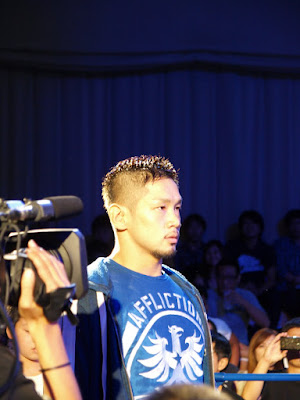
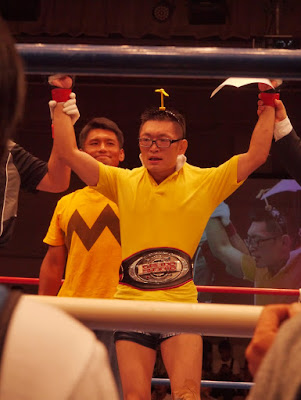
It's baaack! This is the 2017 edition of the annual Fighters to Watch For series.
Yoshitaka
Naito is excluded from this year’s list because he fought for One FC
and won their world title, but will we see his long-awaited match
against Mitsuhisa Sunabe? I hope so. Tatsumitsu Wada competed for Rizin
and defeated Kai Kara-France, so I left him off of this prospects list
as well.
Since UFC Fight Pass has added Shooto and Pancrase, I think that you'll enjoy this list even more than before.
Ishiwatari's
2016 campaign was defined by avenging his loss to Jonathan Brookins. He
defeated Brookins in spite of Brookins missing weight, which is worth
more than an average win. Ishiwatari was continuously taken down and
lost a decision to Brookins in their first fight, but he defeated his
overweight opponent with sprawls in the rematch that showcased his
improved takedown defense.
Tamaru
earned his biggest career win in 2016 against Yasuhiro Urushitani. He
did not allow Urushitani to use his striking pressure and submitted
Urushitani with an armbar. Even though Urushitani is in the twilight of
his career and declared that he will retire after his next fight, Tamaru
needed just one round to become the fastest man to ever finish him.
Kanbe
battled injuries throughout 2016, but he did engage in a semi-brawl situation with Jarred Brooks. I look forward to major promotions
building strawweight classes so that they can face each other.
Mizuki
continued her winning streak with three finishes in 2016 before
suffering a knee injury. She is not yet in the UFC rankings due to being
outside of the organization, but we all know she should be in there.
Mizuki's
little brother scored his biggest win to date in 2016 when he defeated
Yuya Shibata, who is a former DEEP title challenger. Of course, the
Inoue siblings are best known as strikers, but Naoki has used his
excellent submission skills to finish seven of his nine professional
opponents, and remains unbeaten.
Suzuki’s
lone fight in 2016 ended in a first-round submission victory over
Seok-Yong Kim. We need to see him compete for higher stakes this year.
Hopefully the rumored Rizin Flyweight Grand Prix picks him up.
Kurosawa
captured Shooto gold in 2016 when he defeated Ryuto Sawada again. He is
a teammate of Yoshitaka Naito, who is One FC champion. I expect
Kurosawa to face international opposition this year, which will
hopefully help to develop and showcase atomweight competition around the
world.
Even
though she lost to Rin Nakai, Murata is still very early in her MMA
career. I do not think that she was in the best physical condition
against Nakai, and I expect that she will face appropriate opponents in
fights that allow her to develop her skills this year.
Big thanks to Robert Sargent (MMA Rising) for English editing.
We're back with the 2016 edition of Fighters to Watch For.
The most pleasant thing from last year's list was Hisaki Kato's knockout of Joe Schilling in Bellator. I mentioned Kato in the 2015 list and he was quite unknown beforehand due to the fact that his fights in HEAT were not well-known. I personally believe that I contributed to increasing his recognition.
Hisaki Kato is now in Bellator, so he is excluded from this list. Ayaka Hamasaki (Invicta champ) and Yuki Motoya (Rizin) should get attention without my inclusion, so I excluded them this year. I hope you enjoy watching rookie fighters grow like I do.
Matsushima debuted in February and he fought five times in 2015. He finished all of the fights and four of them ended in the first round. He has not had any competitive fights yet, and I want him to have good striking training because I think there is danger if he can't get a proper striking coach. Other than that, he is physically the best rookie since Kyoji Horiguchi.
See video of his slam KO in PXC: and his KO in Shooto:
While Motoya had a no contest in Rizin, Wada had two fights against Korean fighters in 2015. He has not recently faced quality opponents in Japan besides Motoya and Ogikubo. He will face Jae Nam Yoo at Deep: 75 Impact.
Ishiwatari suffered an injury early this past year. He fought Victor Henry in December and it was Japanese MMA's Fight of the Year. He has been unable to win against some of the elite opponents in his career, but I still want to see him in the major MMA scene because his fights are almost always very entertaining.
Kanbe was crowned as the Pancrase light flyweight champion this past year with a one-sided beating of Yukitaka Musashi. He needs to change divisions now since Pancrase adopted the unified weight classes. I'm looking forward to watching him face the champion in a different weight class.
In 2015, Naito beat younger strawweight fighters like Ryuto Sawada, and I previously named Sawada as a fighter to watch out for. Naito is always looking for takedowns and ground and pound to set up submissions, and he engages in fun scrambles during fights. I hope he appears in a major promotion to help build a new division. He has the gimmick of "Nobita," which is derived from the famous manga character "Draemon."
Mizuki had a rough 2015 with a loss against Alexa Grasso and a difficult fight against Emi Fujino. She began 2016 with a win against Lacey Schuckman, but I hope that she improves her physical power and wrestling.
Suzuki is not well-known as a prospect because he fights for Grachan, which has a small fan base, but his win against Shooto ranker Yosuke Saruta definitely gave him recognition in the JMMA world. He was crowned as Grachan champ in September. I hope he will face other organizations' champions in order to further elevate his status.
Kurosawa was knocked out by Junji Ito and Sawada was submitted by Yoshitaka Naito in 2015, but both are young and talented. Sawada is only 20 and Kurosawa is 22.
Kanako Murata
Murata has not yet debuted in MMA, but she is the first Japanese female athlete with such a high amateur status to convert to MMA. She had a wrestling match against Saori Yoshida and almost won the match before losing it in the late stages. Of course, I don't know how well she can adapt to MMA, but I can't hide my anticipation.
Big thanks to Robert Sargent (MMA Rising) for English editing.
Here
is the 2015 edition of Fighters to Watch For. Michinori Tanaka and
Uruka Sasaki landed themselves a spot in a major organization (UFC) last
year. There is, of course, a few new faces this time around and we have
more fighters with clean records. How I evaluate is based upon who won
against whom, but if a specific performance convinced me, I’ve done a
more risky pick. I hope that, with this list, hardcore MMA fans will
take note of who are JMMA's up-and-comers.
Motoya's
2014 was an active one and perfect for what he wanted. He avenged a
loss against Tatsumitsu Wada and won his first international fight
against former RFA champ Matt Manzanares. He used a variety of kicks to
make his movements harder to read and his front kicks stopped
Manzanares's pressure. Motoya is the most highly-touted rookie who
remains in local Japanese promotions and he will soon move on to fight
in a major organization.
Wada
lost his DEEP flyweight strap against Motoya this past year, but his
year-end performance against Ryuichi Miki defined him as a top-three
Japanese flyweight. Wada is known for his boxing skills and often
continuously jabs his opponents. Not only that, he avoided Miki's
strike-takedown combinations and finished Miki with a rear-naked choke.
Ogikubo's
year was all about winning the VTJ flyweight tournament. He had a
competitive fight against Takeshi Kasugai, but after that he choked out
Kana Hyatt and showed positional grappling superiority against Czar
Sklavos. Ogikubo asked for a fight against Yuki Motoya, but his injury
prevented the fight.
Ando
signed with One FC and his wins against Rafael Nunes and Zorobabel
Moreira both ended with finishes but in different ways. He choked Nunes
and tapped him out, then fought a striking battle against the
huge-framed Moreira. Ando forced Zoro to fight passively after
pressuring him and, with Zoro’s mind weakened, Ando finished him with a
body shot.
Nakahara's
2014 did not go well because he did not have an opportunity to fight.
He was supposed to face Honggang Yao, but the fight was scrapped because
Yao missed weight. When I think about Nakahara’s record and improvement
curve, he remains here on this list.
Kato
is not yet well-known, but he is the current HEAT middleweight champion
and also a Daidojuku champion. HEAT is a Nagoya-based organization, so I
haven't watched his fights yet, but from his record and quick finishing
times he should be seen as at least a top-three Japanese middleweight.
Another reason why I am interested in him is his Daidojuku skill. The
first Japanese fighter in the UFC was Minoki Ichihara and he had no
solution against Royce Gracie's grappling, but after all of these years
of MMA evolution, perhaps Daidojuku can contribute to major MMA's style
diversity? That's not a pure fighter evaluation, but I am interested in
him for such a reason, too.
Ayaka's
2014 was about testing herself in a new division. She dominated former
Jewels featherweight champ Naho Sugiyama in striking and on the ground,
then fought and defeated Mei Yamaguchi. We can expect that she will soon
fight in the U.S. since she did not participate in the DEEP Jewels
featherweight GP, which is being held in her new division.
Mizuki's
2014 did not go how she had wanted. She missed weight in the finals of
the DEEP Jewels lightweight GP and lost by DQ even though she submitted
Emi Tomimatsu. She avenged her “loss” against Tomimatsu in her next
fight to become Deep Jewels featherweight champion. Mizuki next fought
Karolina Kowalkiewicz at Invicta FC 9, but her precision striking was
not favored against Karolina's volume of strikes. She will begin 2015
against Alexa Grasso at Invicta FC 11. Mizuki is still only 20 years
old, but she needs to develop more physical strength to give her
precision striking more value.
Kanbe
may not be expected to be on this list because he is so early in his
career at 18 years old, but his dominance over opponents with his
grappling made me convinced that he needed to be included here. Kanbe
trains at Alliance Square and is a grappling-based prospect at the
moment. His strong point is obviously his ground game, but we know that
current fighters in major promotions can't rely too much upon grappling.
Alliance Square’s coach, Tsuyoshi Kosaka, knows how to build MMA
talent, so I think that Kanbe will develop considerable striking skills
but I don't know how far he can go. I think we will someday see him
challenge for a Pancrase title.
Kanbe
is Pancrase's lightest weight prospect. I don't know if he will fight
in the upper divisions in the future, but Shooto's lightest prospect is
Ryohei Kurosawa. His nickname, “Ken Asuka,” is from Karate Manga. His
style is karate, which he began training at age six, but what impressed
me most was his sprawl against the takedowns of Ryuto Sawada, who is a
top prospect.
Ando's
career is too short yet, with only three fights so far, but he was a
top-three wrestler in college. In his third bout, he beat Takahiro
Ashida, who has 16 fights on his record and fought to a split decision
against Miguel Torres. It shows Ando’s potential and what kind of
athlete he is.
Sawada
had a breakout performance after his loss against Kurosawa. He outpaced
and outwrestled Yuki Shojo for the entire fight and ground-and-pound
KOed him. That was surprising for me since Ryuto is small for Shooto’s
flyweight division. He displayed big KO power against Shojo, who only
had one prior TKO loss in his career. Sawada is expected to face
champion Yoshitaka Naito next year.
Big thanks to Robert Sargent (MMA Rising) for English editing.
DEEP Jewels hits ustream PPV again with two Invicta veteran.
Mizuki Inoue rematches Emi Tomimatsu. Mizuki Inoue missed weight at last match against Emi. Which was title fight. So I understand Mizuki don't win a belt if she win.But Mizuki can't score win even she submit Emi.Because of ruled as DQ lose.Of course I don't defend Mizuki missed the weight, but I don't like finish didn't define the fight.I personally think If Mizuki don't score finish, give Emi a decision nod is fair point of that situation.(I know it's not become fair anyway though.)
So I do think Emi don't like the fact do not win at actual fight and become champ.That's make this instant rematch.I hope Mizuki make weight and people more discuss about how to treat over weight fighter.
Ayaka Hamasaki will debut at 106, face former champ Naho Sugiyama is important fight for that days too.Curious how Ayaka's condition after surgery, which defines her future.
DEEP Jewels 5 will stream August 9 17:30 (Japanese time)
Here is the 2014 edition of Fighters to Watch For. Kyoji Horiguchi landed himself a spot in a major organization (UFC), but there are many newcomers on this year's list.
Tanaka's 2013 campaign involved winning a championship in Guam/Philippines promotion PXC and carefully developing his career. While fighters he has defeated have begun to land themselves positions in the UFC, Tanaka's coach Katsumura has a conservative plan for his career. I think he needs improvement in his striking, but his grappling is already top-level. Tanaka went to donate money to the Philippines embassy for victims of Haiyan and I am looking forward to his 2014 campaign.
Sasaki beat Wajyutsu Keisyukai mentor Tetsu Suzuki and took Shooto's Pacific rim title during his 2013 campaign, and he beat Naoya Uematsu in a grappling match. He has become Japanese MMA's best grappler in his weight class. I am curious about what will happen when he can't take opponents down. He struggled against Kota Onojima when he could not get him down. His 2014 campaign starts with a fight against Keisuke Fujiwara, who is ZST champ.
Ishiwatari's 2013 campaign did not go the way that he had wanted it to. He lost to Shooto champ and current UFC fighter Kyoji Horiguchi in the Japanese fight of the year and best comeback in Japanese local MMA history. His 2014 campaign begins with a title defense against Yo Saito, who is known as a guillotine specialist.
Inoue's 2013 campaign is best remembered for her first appearance in Invicta FC. She showed continuous improvement in her striking against Bec Hyatt. In that fight, she won clearly, but it wasn't a perfect game since she get overpowered in the clinch. After that, Inoue faced Emi Fujino, who has outstanding power for a Japanese female MMA fighter, but Fujino never got a chance to use that power. I saw drastic improvement in Inoue and I am looking forward to her next fight against Emi Tomimatsu.
In 2013, Ando was best known for becoming a champion for Legend FC. Not only that, but he became champ by defeating Jadamba Narantungalag, who is considered to be one of top talents in the Asian MMA scene. Their fight ended due to an unfortunate ankle injury when Jadamba's weight was only supported by his right leg and his ankle broke, but Ando's win is legit since he led the fight at that point. His 2014 campaign will decide how his new contract goes and hopefully he will fight again soon.
Nakahara's only fight in 2013 was against UFC veteran Marcos Vinicius Borges Pancini for Rebel FC. He finished Pancini, but I want to emphasize that his left body shot determined how the fight went. It's hard to land effective body blows in the lower weight classes.
Last year's Shooto Rookie tournament MVP was Paraestra Matsudo's Takaki Soya. 2012's MVP Masatsugu Sakaki, 2011's MVP Michinori Tanaka and 2010's MVP Kyoji Horiguchi are all still unbeaten in their professional MMA careers. Before entering the tournament, Soya won the East Japan Amateur Shoooto tournament and became the youngest professional Shooto fighter at age 17.
This year's rookie tournament's number of participants was reduced because of Shooto's policy change for non-Tokyo fighters who build their early careers in the regions where they live. That reduced regional promoters' expenses, but at the same time I can't say that this year's rookie tournament was the same as the previous three in terms of quality.
Still, I can say that Soya is a good finisher. I can't say that he'll become a local Japanese champ because bantamweight is the most crowded division in this country and the fighters he faced in the tournament aren't as good as the ones that Horiguchi and Tanaka faced in their tournaments. Shooto Rookie tournaments are still high quality and they bring about awareness of young talent like Soya.
I said last year that I was looking forward to the DEEP flyweights and Tatsumitsu Wada vs. Yuki Motoya was one of the best fights of 2013 in DEEP. Wada took down Shooto striker Haruo Ochi for a decision win. Former champ Yuki Motoya got a decision win over Pancrase champ Kiyotaka Shimizu. With those wins over rival organizations' champs and contenders, I feel that DEEP's most high-level weight class is flyweight.
Last year, one of the best upsets was Mikihito Yamagami's decision win over Mamoru Yamaguchi. Yamagami succeeded by continuously taking the back of Mamoru. Allowing back-takes is considered to be a primary fault in Mamoru's fighting style, but people did not expect that Yamagami would be able to exploit that so well. Yamagami used 2013 to build up his body for a new weight class and he will appear for Road FC this year.
Horiguchi went 3-1 in 2012, including his biggest win to date against Ian Loveland. His game is not without holes, however. When he's taken down, he normally tries to defend against submissions and works at his opponent's pace.He's a bantamweight with a flyweight frame, so it's harder for him to defend takedowns with a sprawl. He either has to control the distance completely or bank on his opponent having poor takedowns.
From a grappling perspective, Tanaka is ahead of all other Japanese MMA rookies. His 2012 campaign saw him fight just two times, as many Shooto Class B opponents and even some Class A fighters did not want to fight him.Because of that, Tanaka and his management chose to sign with Pacific Xtreme Combat. Tanaka defeated Russell Doane with chain grappling in his PXC debut in November. He has power, but he needs to work on making fewer mistakes while he builds up cage experience. He'll next face Joe Taimanglo at PXC 35.
One of the most enjoyable local fights of the year took place in September when Ishiwatari faced veteran Caol Uno. Ishiwatari knew how to control the fight. His distance, takedowns and striking were all well-coordinated.Ishiwatari's style most closely resembles the current American fighting style. His gym, Cave, is worth checking out and is also home to standouts Mizuto Hirota and Ryuichi Miki.
Hamasaki was active in 2012 and picked up a big win against legendary opponent Yuka Tsuji. While it is unfortunate that the fight happened so late in Tsuji's career, Hamasaki still dominated with better wrestling skills.Hamasaki was also successful in her cage debut at Invicta FC 2 in July. She tested herself in the cage environment and that was a smart decision. Previously, her career had been developed in Jewels, where a ring was used for all fights until very recently.
Hamasaki closed out the year with a win against Emi Fujino, who had more power than her, but Hamasaki showed a nice variety of wrestling and positional skills. She was able to counter Fujino's strikes with takedowns and controlled the grappling exchanges.After a strong 2012 campaign that included the two fights in a cage, it is likely that Hamasaki will continue to have a bright future in international competition.
Known for her sensational striking skills as a rookie, Mizuki Inoue had two MMA fights in 2012 and also won the 53.5 kg division of the Shoot Boxing Girls S-Cup. She is still best-known for her striking, but has also worked hard to improve her ground game.All of Inoue's MMA victories, including 2012 wins over Hyo Kyung Song and Alex Chambers, have come by way of armbar submission. Whether she stays in Japan to face the upper tier of Japanese female fighters - such as Mei Yamaguchi and Kyoko Takabayashi - or travels abroad, we will see interesting challenges ahead for her.
"Isao" debuted in 2008 and belongs to the Sakaguchi Dojo, which is led by Yukio Sakaguchi. Because Sakaguchi's father, Seiji, is a pro wrestler, fans were skeptical about how serious Yukio and his gym really were. After Yukio's hard-fought bout against Kotetsu Boku, however, the Sakaguchi Dojo attracted more attention.At the time, Pancrase had interesting lightweight prospects and they staged a grand prix for a lightweight title shot. Kobayashi won the tournament and went on to defeat champion Koji Oishi in a rematch, avenging his only loss in the process. He also holds a TKO win over Kazuki Tokudome, who will join the UFC this year.
The UFC offer to Tokudome first went to Isao, but Sakaguchi Dojo has a conservative plan for building Isao. Ideally, he will get more experience training and fighting in a cage if he chooses to maintain a conservative plan before joining a major promotion like the UFC.
Last year, flyweight Yuki Motoya was crowned as the youngest DEEP champion at 22 years of age, but he has tough oppositon ahead of him in the near future. DEEP bantamweight contender Tatsumitsu Wada has indicated that he plans to drop to flyweight and he has his sights set on the championship.As well, another bantamweight contender, Yusaku Nakamura, is also considering making the move down to flyweight. This means that there is a strong division developing. We must see where these flyweights become ranked on the regional scene, but it is shaping up to be quite interesting.